
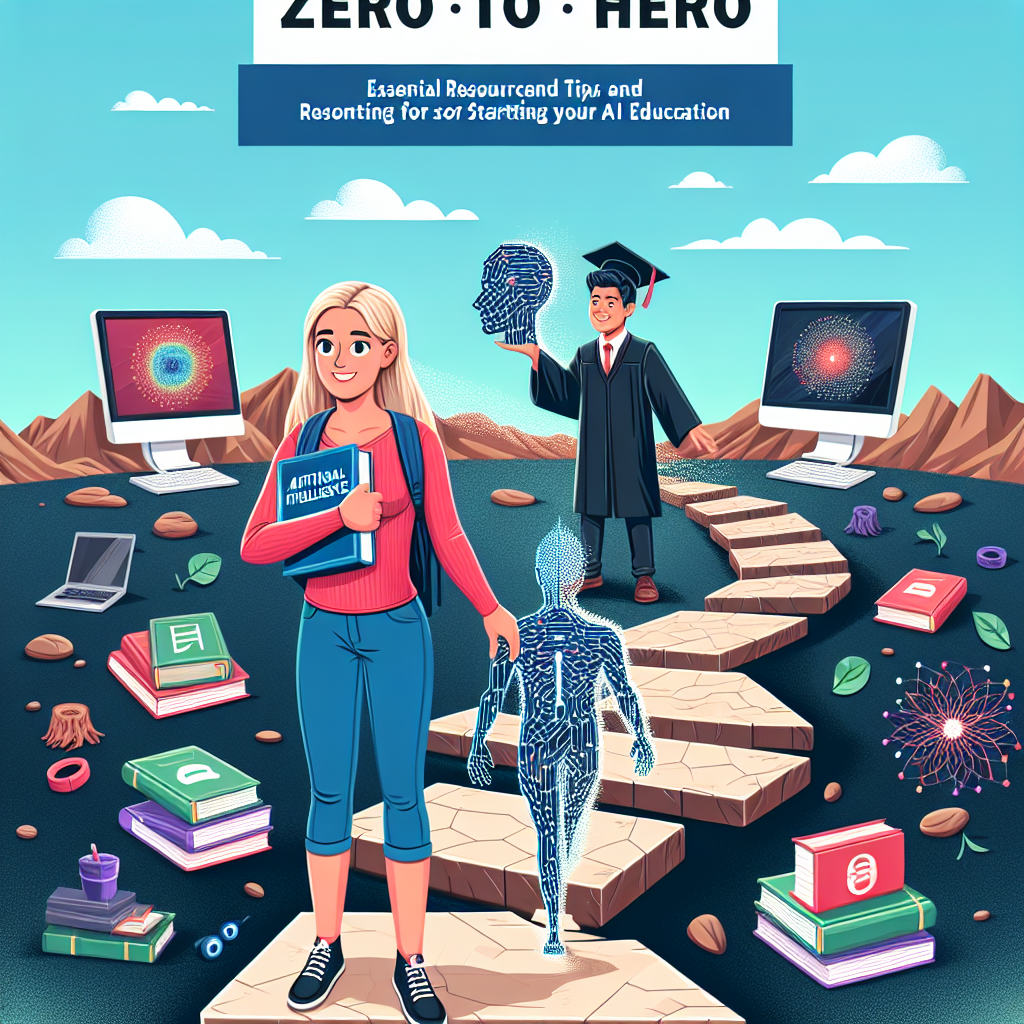
Artificial Intelligence (AI) is revolutionizing industries across the globe, and its applications are burgeoning in areas such as healthcare, finance, marketing, and robotics. For anyone looking to delve into AI, the journey might seem daunting. However, with the right resources and strategies, you can successfully transition from a novice to an AI expert. This guide will provide essential resources and tips to help you start your AI education and transform into an AI hero.
Understanding the Basics
Before delving into AI, it’s crucial to understand its foundational concepts. AI can be divided into three main categories: Artificial Narrow Intelligence (ANI), Artificial General Intelligence (AGI), and Artificial Superintelligence (ASI). Today, most AI applications fall under ANI, which encompasses systems designed to perform specific tasks.
Key Concepts
-
Machine Learning (ML): A subset of AI that focuses on building systems that can learn from data. It includes supervised, unsupervised, and reinforcement learning.
-
Deep Learning: A subset of ML that uses neural networks with many layers to analyze various factors of data. It’s particularly impactful in image and speech recognition.
-
Natural Language Processing (NLP): A field of AI that helps computers understand, interpret, and respond to human language.
- Data Science: The field of study that deals with large volumes of data and uses various techniques to extract insights.
Educational Pathways
Online Courses
Numerous online platforms offer comprehensive AI courses suitable for beginners:
-
Coursera: Offers courses from top universities such as Stanford and MIT. Andrew Ng’s “Machine Learning” course is highly recommended for beginners.
-
edX: Provides access to numerous AI courses, including those from Harvard and Columbia. edX courses often come with certificates.
-
Udacity: Known for its nanodegree programs, Udacity offers focused courses on AI, machine learning, and deep learning.
- Kaggle: While primarily a platform for data science competitions, Kaggle also offers micro-courses to quickly get started with ML and data science concepts.
Books
Books provide a comprehensive understanding and a deeper dive into AI concepts:
-
"Artificial Intelligence: A Modern Approach" by Stuart Russell and Peter Norvig: A foundational text that covers a wide range of topics in AI.
-
"Deep Learning" by Ian Goodfellow, Yoshua Bengio, and Aaron Courville: A comprehensive book for those interested in deep learning.
- "Pattern Recognition and Machine Learning" by Christopher Bishop: Offers insights into the mathematical underpinnings of ML.
Interactive Tools
-
Google Colab: A free Jupyter notebook environment that requires no setup, helping you test your AI code on Google’s hardware.
-
Keras and TensorFlow: High-level neural networks APIs that can work on top of TensorFlow. Both are beginner-friendly and heavily used in the industry.
- PyTorch: An open-source ML library based on the Torch library, popular for its simplicity and dynamic computational graph support.
Building a Strong Foundation in Mathematics
AI and ML are heavily based on mathematical concepts. A solid understanding of the following areas is essential:
-
Linear Algebra: Understand matrices and vectors, which are crucial for manipulating datasets.
-
Calculus: Focus on derivatives and integrals, which are fundamental for understanding algorithms that involve optimization.
-
Statistics and Probability: Crucial for making predictions and interpreting data.
- Discrete Mathematics: Useful for understanding algorithms and other computer science concepts.
Online resources like Khan Academy and MIT OpenCourseWare offer free courses in these subjects.
Practical Experience
Theory without practice doesn’t lead far. Here’s how to gain real-world experience:
Projects
Working on projects helps solidify your understanding of AI concepts:
-
Personal Projects: Implement simple ML models and gradually increase complexity. Ideas include building a recommendation system or playing with image recognition.
- Open Source Contributions: Join AI-related open-source projects on GitHub to gain collaborative experience.
Competitions
Participating in AI competitions can be both rewarding and educational:
-
Kaggle Competitions: Solve real-world problems and compete with other data scientists worldwide.
- Topcoder: Participate in coding competitions to improve your problem-solving skills.
Internships and Networking
Gaining industry experience through internships can provide insights into the application of AI in business:
-
Internships: Look for internships that provide hands-on experience. They are invaluable for learning how AI is implemented in real-world situations.
- Networking: Join AI communities on platforms like LinkedIn, Reddit, or specialized forums. Attend AI conferences, webinars, and meetups to connect with professionals in the field.
Continuing Education and Staying Updated
AI is a rapidly evolving field. It’s crucial to stay updated with the latest trends and advancements:
Research Papers
Regularly reading research papers will keep you informed about the cutting-edge developments in AI. Get started on platforms like arXiv or Google Scholar.
Follow Thought Leaders
Following AI researchers and practitioners on social media platforms like Twitter or LinkedIn can provide insights into industry trends and emerging technologies.
Newsletters and Blogs
-
Towards Data Science: A popular Medium publication covering data science topics.
-
AI Weekly: A newsletter that curates the latest in the world of AI.
- DeepAI: Offers news, research, and interviews related to AI advancements.
Essential Soft Skills
Beyond technical knowledge, certain soft skills are crucial in the AI field:
-
Problem-Solving: Ability to think critically and solve complex problems efficiently.
-
Communication: Articulating your ideas and findings clearly to both technical and non-technical audiences.
- Adaptability: The willingness to learn and adapt to new tools, technologies, and methodologies.
Conclusion
Starting from zero and aiming to become a hero in the world of AI is an exciting journey. By leveraging the right resources and maintaining a consistent and curious learning approach, you can master AI theories and practices. Remember, the key is to balance theoretical knowledge with practical experience, continually explore new areas, and stay connected with the AI community. With dedication and perseverance, you’ll be well on your way to becoming an AI expert.